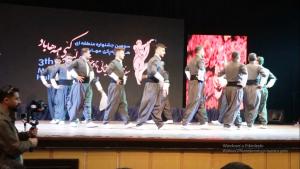

Ten Kurdish dance troupes are performing this week to rapt audiences in the western Iranian city of Mahabad’s third annual dance festival that celebrates Kurdish culture and heritage.
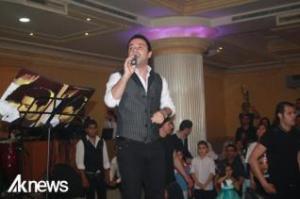
“We are very pleased to be here today. This vibrant gathering, with the participation of these groups, has created a wonderful atmosphere and brought joy to the festival. Its importance lies in promoting unity among all Kurds, and it reflects the richness of our culture and art,” singer Mani Bruska told Rudaw.
The festival features the traditional Kurdish folk dance halparke, performed by mixed groups of men and women holding hands, a custom often discouraged by Iran’s political and religious authorities.
On the first day, a halparke carnival was held on Tawheed Bridge, followed by an exhibition of halparke-themed portraits at Wahdat Hall.
Kurdish culture is what has sustained Kurds who have faced oppression where they live in Iran, Iraq, Turkey, and Syria, said festival-goer Mardin Khalili.
“Our language, culture, and artistic traditions have carried us through the centuries. After so many years, we are still here, alive and thriving,” he said.
Throughout the two-day festival, dance troupes are performing in Mahabad’s public bazaars and parks. On Friday evening, a committee at Wahdat Hall will select the festival’s best dancers.
Mahabad holds deep significance as a symbol of Kurdish nationalism. It was the site of the first independent, albeit short-lived Kurdish state established by Qazi Muhammad in 1946. The city remains a focal point of Kurdish resistance, representing the enduring struggle for self-determination and national identity.
rudaw